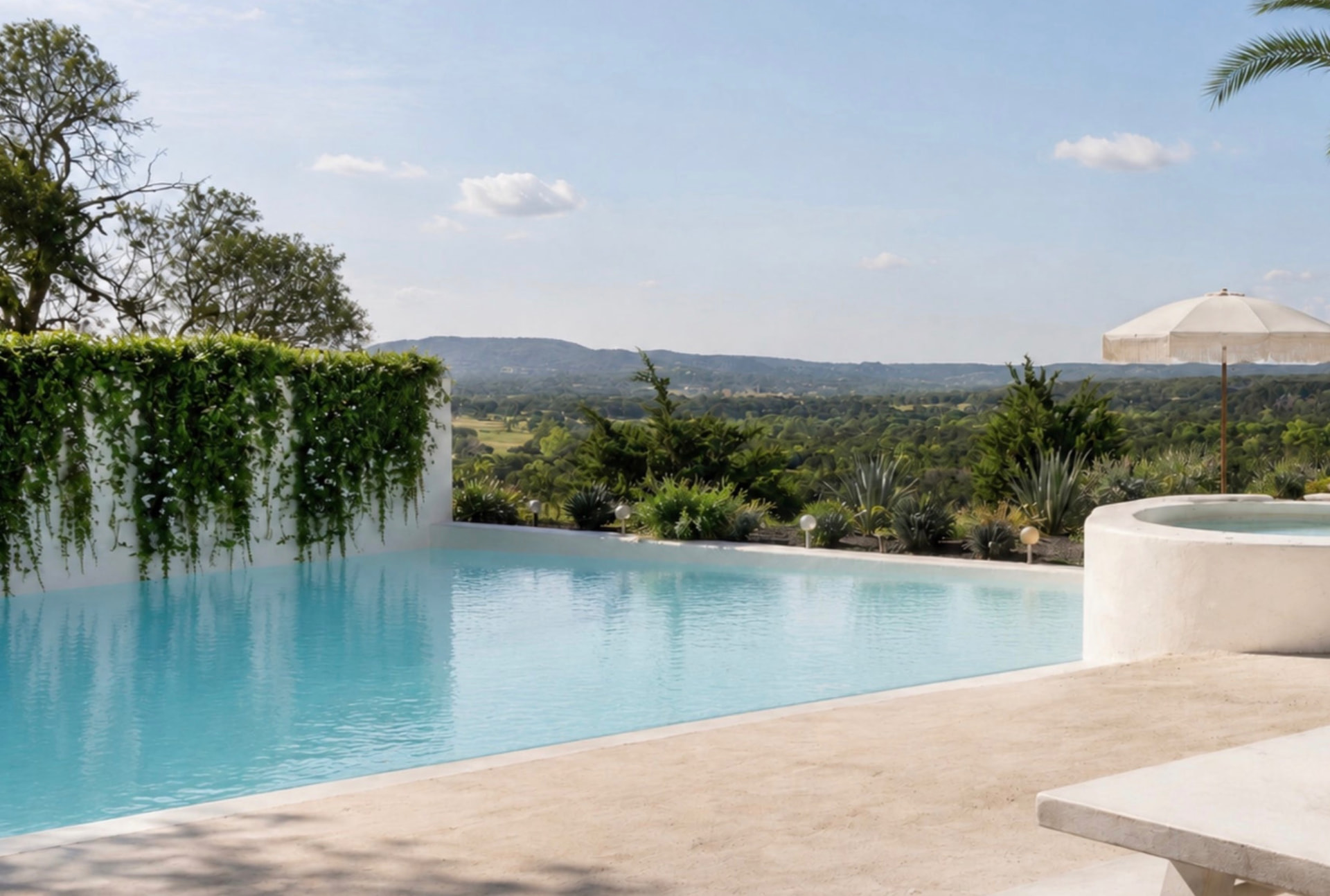
Pool Era field notes · Finishes and renovation
Limestone, Travertine or Concrete Coping With a Salt Pool
Love the look of Hill Country limestone but worried a salt pool will eat it? It is a fair worry. Soft stone, salt water and strong sun can be hard on each other.
The right stone, a good sealer and some simple care go a long way. Here is what to know.
The stone
Why limestone and travertine are sensitive.
The Natural Stone Institute says limestone and travertine have a calcium carbonate base, so even mild acids can change them. It also says limestone absorption ranges from slight, under 1%, to high, over 10%.[1]
So two limestones can behave very differently next to the same pool. A denser stone soaks up less water, and less salt with it.
Salt
What salt water does.
A salt pool is still a chlorine pool. A salt cell turns dissolved salt into chlorine. That means the water splashing onto your coping is salty, and when it dries in the sun, the salt stays behind.
When salty water soaks into porous stone and dries, salt can crystallize inside the pores. Over time that can flake or pit the surface. Splash, wet feet and wind-blown spray all add up.
Choosing
Picking stone for a salt pool.
- Ask about absorption. Your supplier should be able to tell you how much water a stone absorbs.
- Look at denser stone. The Natural Stone Institute says dolomitic limestones generally have higher density and lower absorption than calcium carbonate limestones.[1]
- Consider concrete or cast stone. These can give a similar look, and they are often easier to seal and replace.
- See it wet. Splash water on a sample. Watch the color and how fast it soaks in.
Care
Simple care that helps.
- Rinse the coping with fresh water now and then, especially in dry, windy weeks.
- Ask your installer which sealer suits the stone and how often to reapply it. Follow the sealer maker's directions.
- Keep pH in range. CDC recommends a pH of 7.0 to 7.8 for pools.[2]
- Watch for flaking early. Small spots are easier to deal with than a full coping replacement.
Every stone and every site is different. If you are planning new coping, we can talk through options for your pool.
Related
More field notes
 Finishes and renovationPlaster, Quartz or Pebble: Choosing a Pool Finish in the Hill CountryHow plaster, quartz and pebble differ in feel, lifespan and upkeep with hard water.Read
 Care and ownershipHard Water and White Scale on Pool TileWhy white crust builds up on tile, and how to slow it down safely.Read
 Finishes and renovationSigns It's Time to Replaster Your Pool (and When It Isn't)Rough spots, stains and worn patches: when to replaster and when it is just the water.Read
Sources
Where these facts come from
Sources checked October 25, 2026. Rules, fees and water stages change; check the source before you rely on a number.
Before you rely on this. This field note is general information, not professional, engineering or legal advice. Every pool and every site is different. What Pool Era does on your project, how and with what warranty, is only what your written agreement says. Local codes and HOA rules change, so check with your city, county or HOA before you rely on anything here. Website terms